Online course
AI in Clinical Practice
Use AI effectively while protecting clinical reasoning
140 minutes · Final assessment · Certificate of completion
Built for clinicians in training
Clinically grounded learning
Applicable across AI tools
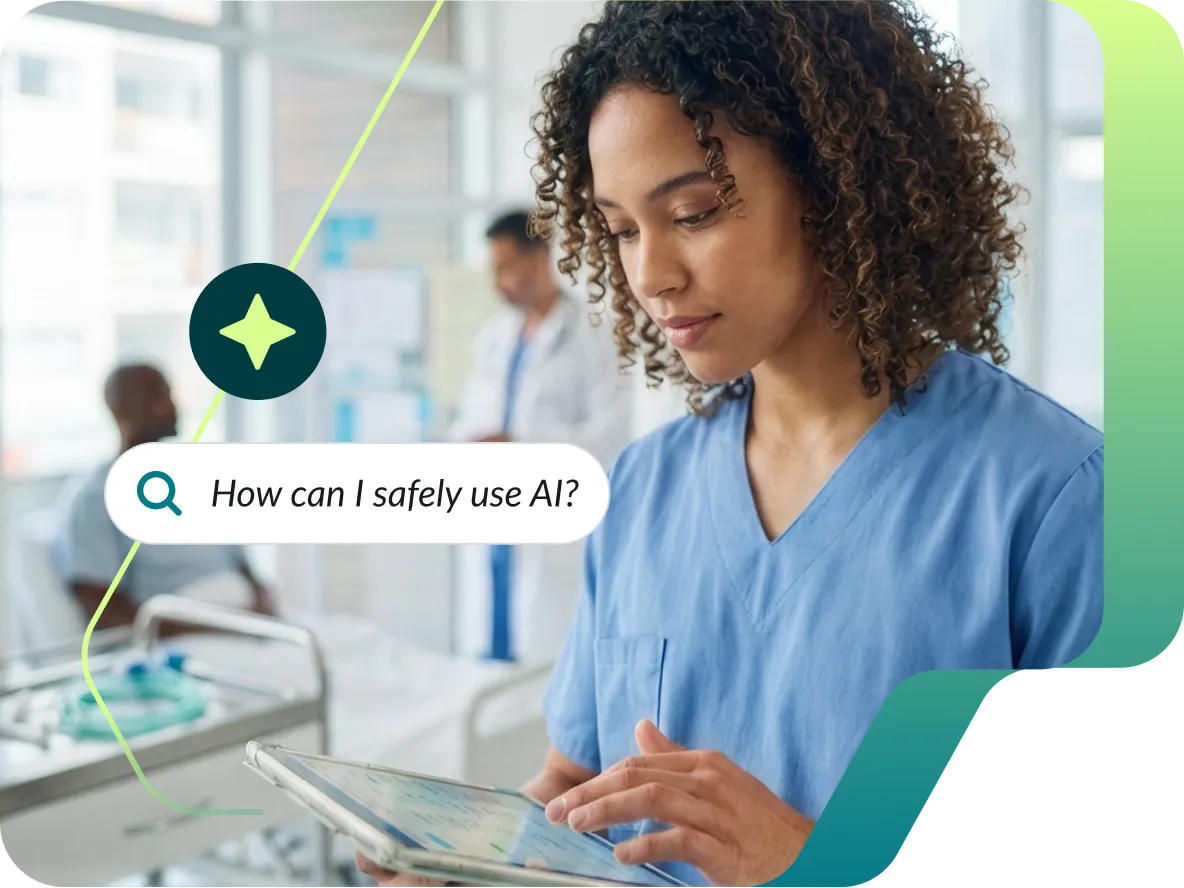


Protecting reasoning as it develops
AI can make clinicians in training faster today, but overreliance shortcuts the deliberate thinking they need to become better clinicians tomorrow.
When AI replaces rather than supports independent reasoning, it can lead to cognitive surrender and never-skilling. "AI in clinical practice" teaches learners how to recognize and avoid both.
Through realistic clinical scenarios, participants learn how to use AI responsibly, critically evaluating its outputs, and deciding when to trust, question, or override it.
For institutions, the course provides a consistent standard for responsible AI use, with a record of completion for every learner.
Why AMBOSS
For over a decade, AMBOSS has supported medical professionals across learning, clinical care, and teaching. Today, we’re also helping to shape the use of AI in medicine.
- Clinical AI: AMBOSS AI ranked #1 among purpose-built clinical AI tools in the Stanford–Harvard NOHARM study.
- Clinician educators: This course was created and presented by senior AMBOSS clinical editors with extensive experience as physicians and medical educators.
Curriculum overview
Use AI without outsourcing clinical reasoning
Recognize automation bias, cognitive surrender, and never-skilling, and apply practical strategies to keep independent clinical reasoning at the center of decision-making.
Know when to trust an AI tool
Evaluate different types of clinical AI, assess the evidence behind a tool, and recognize the red flags that warrant further scrutiny.
Identify what AI omits or gets wrong
Scrutinize AI output for failure modes such as hallucinations, omissions, and bias before they affect clinical decisions.
Know the responsibilities of using AI in patient care
Protect patient information and navigate accountability, disclosure, institutional policy, and supervision when AI contributes to clinical work.
Use AI to become a better clinician, not just a faster one
Write more effective clinical prompts, know how to use AI to expand rather than replace clinical thinking, and turn actual cases into focused learning rather than using AI to simply generate answers.
Medical knowledge
- Evaluating AI-generated management plans
- Identifying the need for clinician oversight.
Practice-based learning
- Critically appraising AI tools
- Evaluating algorithmic bias
- Recognizing the risk of cognitive surrender
Professionalism
- Using AI transparently
- Communicating and documenting AI use
Systems-based practice
- Understanding the integration of AI tools into clinical workflows
- Complying with health data privacy requirements
A final assessment evaluates learners' understanding and application of core concepts. A passing score is required to receive a certificate of completion.
Bring "AI in clinical practice" to your institution
AMBOSS offers institutional access to the course.
Connect with our team to review the full course curriculum and explore institutional pricing and implementation.
Experts

Maryann Overland, MD
Dr. Maryann Overland is a general internist, clinician educator, and Deputy Editor at AMBOSS. She previously served as Associate Program Director of the Internal Medicine Residency Program at the University of Washington, where she was also Associate Professor of Medicine. Her career spans clinical practice, residency education, and medical education technology, giving her firsthand experience in how clinicians develop clinical reasoning and decision-making throughout training.

Darrell Randle, MD
Dr. Darrell Randle is an anesthesiologist, critical care physician, and Senior Editor at AMBOSS with nearly four decades of experience in clinical and academic medicine. His previous roles include Consultant at Mayo Clinic, Chair of Anesthesia at CommonSpirit, and Medical Director at the University of Minnesota. Across his career, he has combined patient care, clinical leadership, and medical education, bringing extensive experience in clinical reasoning and decision-making to his work at AMBOSS.
Common questions from institutions
No. The course teaches principles and skills that apply across AI tools, including how to assess whether a tool is appropriate for clinical use and how to critically evaluate its output.
The course complements existing policies by helping learners put them into practice, from evaluating AI output and protecting patient information to maintaining responsibility for clinical decisions.
The course can be offered as self-paced learning or assigned as part of an existing curriculum. It consists of short modules, making it easier to integrate into training schedules.
Yes. Institutions can manage course assignments and monitor learner progress, performance, and completion.
Yes. Complete the form and our team will get in touch to share the full curriculum overview and, if helpful, arrange a course demo.





DOWNLOAD OUR APP


© 2026 AMBOSS. All rights reserved.